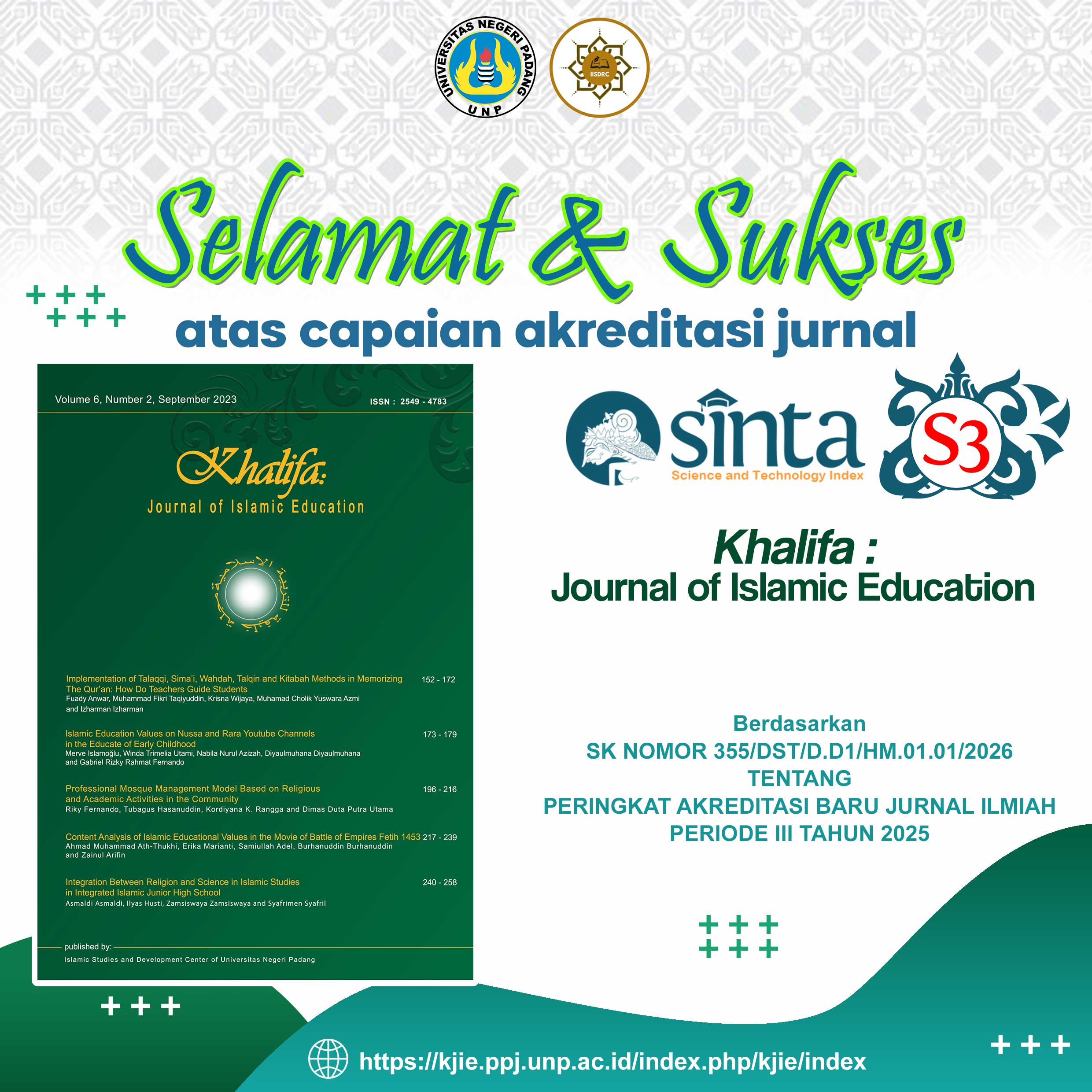
Integrative Parenting Model: A Solution for Child Education in Muslim Families
DOI:
https://doi.org/10.24036/kjie.v9i1.391Keywords:
Gender equality, modern parenting, harmonious familyAbstract
The hustle and bustle of modern life filled with high work demands causes many parents to have difficulty in spending time with their children, hindering the formation of strong emotional relationships between parents and children. The lack of affection and attention from parents can trigger a variety of behavioral problems in children, including the possibility of violence. This article aims to offer a holistic approach to parenting in this digitalization era that combines religious values, culture, and modernity through the concept of Mua'syarah bi Ma'ruf and the principle of Gender Equality. This article is written using a qualitative method with a Systematic Literature Review (SLR) approach that involves a systematic process of searching, selecting, assessing, and synthesizing literature. The literature was cited from reputable journals with screening following the Preferred Reporting Items for Systematic Reviews and Meta-Analyses (PRISMA) guidelines. The analysis shows that an integrative parenting model that integrates the concept of Mu`asyarah bil Ma'ruf and the principle of Gender Equality has great potential in building harmonious families and supporting optimal child development. By emphasizing the importance of open communication, mutual respect, and fair division of tasks this model can overcome various modern parenting challenges, such as the influence of social media and high work demands. The implication of this article is to advise parents to apply the integrative parenting model in parenting their children. This model aims to shape character, instill values, and prepare children to face future challenges by integrating the concept of Mu'asyarah bil Ma'ruf and the Principle of Gender Equality.
References
Abendroth, A.-K. (2020). Gender Equality. In Encyclopedia of Quality of Life and Well-Being Research (pp. 1–4). Springer International Publishing. https://doi.org/10.1007/978-3-319-69909-7_1129-2
Abidin, N. S. Z., Shaifuddin, N., & Saman, W. S. W. M. (2023). Systematic Literature Review of the Bibliotherapy Practices in Public Libraries in Supporting Communities’ Mental Health and Wellbeing. Public Library Quarterly, 42(2), 124–140. https://doi.org/10.1080/01616846.2021.2009291
Akter, S., Rutsaert, P., Luis, J., Htwe, N. M., San, S. S., Raharjo, B., & Pustika, A. (2017). Women’s empowerment and gender equity in agriculture: A different perspective from Southeast Asia. Food Policy, 69, 270–279. https://doi.org/10.1016/j.foodpol.2017.05.003
Albshkar, H. A., Alouzi, K. M., Numan, M., Anuar, K. A. B. A., & Domdom, C. B. (2025). Five Activities to Enhance Spiritual and Emotional Intelligence in International Students. Journal of International Affairs and Students Mobility, 1(1), 29–40. https://doi.org/https://jiasmy.intischolar.id/index.php/jiasmy/article/view/3
Alhidaya, J. P., Wulandari, S. A., Khaira, N., Anugrah, R., Anggraini, T., & Denata, I. (2023). Bebas Kekerasan, Hidup Mengikatku Menjadi Harmonis: Studi Interpretative Phenomenological Analysis Pengalaman Pada Remaja Yang Pernah Mengalami Kekerasan Dalam Keluarga {Free from Violence, Life Binds Me to Harmony: An Interpretative Phenomenological Analysis Study of the Experiences of Adolescents Who Have Experienced Domestic Violence}. Jurnal EMPATI, 12(6), 456–465. https://doi.org/10.14710/empati.2023.39308
Ali, G. T., Salam, R., Achmad, R., & Rohmah, P. A. (2024). Pendidikan Karakter di Era Globalisasi: Anlisis Perbedaan Karakter Generasi di Daerah Perkotaan dan Perdesaan {Character Education in the Era of Globalization: Analysis of Character Differences Between Generations in Urban and Rural Areas}. Masagi: Jurnal Pendidikan Karakter, 1(2), 149–161. https://doi.org/10.29313/masagi.v1i2.5096
An Noor, S. M., Dzukroni, A. A., Nasrullah, N., & Rosyada, M. F. (2024). Rethinking Mu’âsyarah bil Ma’ruf: A Maqâshid Syari’ah Cum-Mubâdalah Approach. AT-TURAS: Jurnal Studi Keislaman, 11(1), 12–24. https://doi.org/10.33650/at-turas.v11i1.7281
Anbar Fauziah, L. (2023). Pandangan Alquran Terhadap Kekerasan Seksual Dalam Rumah Tangga {The Quran's View on Sexual Violence in the Household}. Al-Ibanah, 8(2), 135–158. https://doi.org/10.54801/ibanah.v8i2.203
Antara. (2024). Angka Pengasuhan Tidak Layak Anak Masih Tinggi, Ini Saran Legislator {Child Abuse Rates Remain High, Legislators Offer Recommendations}. Tempo.Com. https://www.tempo.co/gaya-hidup/angka-pengasuhan-tidak-layak-anak-masih-tinggi-ini-saran-legislator-90491
Aprilia, V., Halimah, S., Rhmadhani, A. R., & Komalasari, M. D. (2025). Dampak Kekerasan Dalam Rumah Tangga Terhadap Perkembangan Psikologis Anak {The Impact of Domestic Violence on Children's Psychological Development}. AT-TAKLIM: Jurnal Pendidikan Multidisiplin, 2(1), 511–518. https://doi.org/10.71282/at-taklim.v2i1.85
Aziz, R., & Mangestuti, R. (2021). Membangun Keluarga Harmonis Melalui Cinta Dan Spiritualitas Pada Pasangan Suami Istri Di Provinsi Jawa Timur { Building a Harmonious Family Through Love and Spirituality in Married Couples in East Java Province}. Jurnal Ilmu Keluarga Dan Konsumen, 14(2), 129–139. https://doi.org/10.24156/jikk.2021.14.2.129
Barkah, Q., Huzaimah, A., Rachmiatun, S., Andriya, & Ramdani, Z. (2022). Abandonment of Women’s Rights in Child Marriage; An Islamic Law Perspective. AL-IHKAM: Jurnal Hukum & Pranata Sosial, 17(2), 383–411. https://doi.org/10.19105/al-lhkam.v17i2.6725
Barnwell, A. (2018). Hidden heirlooms: Keeping family secrets across generations. Journal of Sociology, 54(3), 446–460. https://doi.org/10.1177/1440783317727878
Belle, A. B., & Zhao, Y. (2023). Evidence-based decision-making: On the use of systematicity cases to check the compliance of reviews with reporting guidelines such as PRISMA 2020. Expert Systems with Applications, 217, 119569. https://doi.org/10.1016/j.eswa.2023.119569
Bhattarai, P. C., Paudel, D. R., Poudel, T., Gautam, S., Paudel, P. K., Shrestha, M., Ginting, J. I., & Ghimire, D. R. (2022). Prevalence of Early Marriage and Its Underlying Causes in Nepal: A Mixed Methods Study. Social Sciences, 11(4), 177. https://doi.org/10.3390/socsci11040177
BN, A. M. T., Arief, A., & Fadli, F. (2023). Pembaruan Hukum Keluarga di Dunia Islam {Updates to Family Law in the Islamic World}. Familia: Jurnal Hukum Keluarga, 4(1), 34–48. https://doi.org/10.24239/familia.v4i1.83
Brown, M. I., Ratajska, A., Hughes, S. L., Fishman, J. B., Huerta, E., & Chabris, C. F. (2019). The social shapes test: A new measure of social intelligence, mentalizing, and theory of mind. Personality and Individual Differences, 143, 107–117. https://doi.org/10.1016/j.paid.2019.01.035
Carli, L. L. (2020). Women, Gender equality and COVID-19. Gender in Management: An International Journal, 35(7/8), 647–655. https://doi.org/10.1108/GM-07-2020-0236
Carson, V., Hunter, S., Kuzik, N., Wiebe, S. A., Spence, J. C., Friedman, A., Tremblay, M. S., Slater, L., & Hinkley, T. (2016). Systematic review of physical activity and cognitive development in early childhood. Journal of Science and Medicine in Sport, 19(7), 573–578. https://doi.org/10.1016/j.jsams.2015.07.011
Chairilsyah, D. (2020). The Teaching of Reading The Qur’an In Early Childhood. Raudhatul Athfal: Jurnal Pendidikan Islam Anak Usia Dini, 4(2), 192–206. https://doi.org/10.19109/ra.v4i2.6800
Coe, I. R., Wiley, R., & Bekker, L.-G. (2019). Organisational best practices towards gender equality in science and medicine {Organisational best practices towards gender equality in science and medicine}. The Lancet, 393(10171), 587–593. https://doi.org/10.1016/S0140-6736(18)33188-X
Darni, M., & Perdana, D. I. (2024). Penguatan Sosiologi Keluarga Di Dunia Digital: Studi Literasi Pengasuhan Anak Usia Dini Berbasis Keluarga {Strengthening Family Sociology in the Digital World: A Study of Family-Based Early Childhood Parenting Literacy}. RESIPROKAL: Jurnal Riset Sosiologi Progresif Aktual, 6(1), 66–79. https://doi.org/10.29303/resiprokal.v6i1.492
Dean, K. E., & Kawahara, D. M. (2025). Feminist Leadership: Bridging Vision to Reality. Women and Therapy, 48(1), 1–6. https://doi.org/10.1080/02703149.2025.2455823
Dheasari, A. E., Fajriyah, L., & Riska, R. (2022). Tantangan Orang Tua Dalam Mendidik Anak Di Era Digital {The Challenges Parents Face in Raising Children in the Digital Age}. Al-ATHFAL: Jurnal Pendidikan Anak, 3(1), 25–35. https://doi.org/10.46773/al-athfal.v3i1.417
Ediz, M. H., Khairat, H., Dasrizal, D., Hasnah, D. N., Datres, D., Rahmat, A., Sulastri, W., & Zulfadli, Z. (2025). Six Motives of Polygamists in Indonesia. International Journal of Islamic Studies Higher Education, 4(1), 1–12. https://doi.org/https://doi.org/10.24036/insight.v3i3.216
Engkizar, E., Jaafar, A., Alias, M. F. B., Guspita, R., & Albizar, A. (2025). Utilisation of Artificial Intelligence in Quranic Learning: Innovation or Threat? Journal of Quranic Teaching and Learning, 1(2), 73–89.
Engkizar, E., Jaafar, A., Sarianto, D., Ayad, N., Rahman, A., Febriani, A., Oktavia, G., Guspita, R., & Rahman, I. (2024). Analysis of Quran Education Problems in Majority Muslim Countries. International Journal of Islamic Studies Higher Education, 3(1), 65–80. https://doi.org/https://doi.org/10.24036/insight.v3i1.209
Engkizar, E., Jaafar, A., Taufan, M., Rahman, I., Oktavia, G., & Guspita, R. (2023). Quran Teacher: Future Profession or Devotion to the Ummah? International Journal of Multidisciplinary Research of Higher Education (IJMURHICA), 6(4), 196–210. https://doi.org/https://doi.org/10.24036/ijmurhica.v6i4.321
Fahmi, Z. R. (2023). Pembagian Peran Suami dan Istri dalam Membangun Rumah Tangga Sakinah Menurut Syekh Nawawi Al-Bantani {The Division of Roles Between Husband and Wife in Building a Harmonious Household According to Sheikh Nawawi Al-Bantani}. Qanun: Jurnal Hukum Keluarga Islam, 1(1), 1–20. https://doi.org/10.51825/qanun.v1i1.16
Fajrin, N. P., & Purwastuti, L. A. (2022). Keterlibatan Orang tua dalam Pengasuhan Anak pada Dual Earner Family: Sebuah Studi Literatur {Parental Involvement in Child Care in Dual Earner Families: A Literature Review}. Jurnal Obsesi : Jurnal Pendidikan Anak Usia Dini, 6(4), 2725–2734. https://doi.org/10.31004/obsesi.v6i4.1044
Falk, A., & Hermle, J. (2018). Relationship of gender differences in preferences to economic development and gender equality. Science, 362(6412). https://doi.org/10.1126/science.aas9899
Fischer, S., Barnes, R. K., & Kilpatrick, S. (2019). Equipping parents to support their children’s higher education aspirations: a design and evaluation tool. Educational Review, 71(2), 198–217. https://doi.org/10.1080/00131911.2017.1379472
Gadsden, V. L., Ford, M., & Breiner, H. (2016). Parenting Matters: Supporting Parents of Children Ages 0-8. In V. L. Gadsden, M. Ford, & H. Breiner (Eds.), National Academies of Sciences (Vol. 3). National Academies Press. https://doi.org/10.17226/21868
Gutema, D. M., Pant, S., & Nikou, S. (2024). Exploring key themes and trends in international student mobility research —A systematic literature review. Journal of Applied Research in Higher Education, 16(3), 843–861. https://doi.org/10.1108/JARHE-05-2023-0195
Halimatussyadiah, H., Dwi Andrian, F., Sulaeman, & Qalbia. (2024). Harmoni Keluarga: Integrasi Kasih Sayang, Komunikasi Efektif, dan Keseimbangan Hidup dalam Perspektif Islam dan Psikologi Keluarga {Family Harmony: Integrating Love, Effective Communication, and Life Balance from an Islamic and Family Psychology Perspective}. Familia: Jurnal Hukum Keluarga, 5(1), 37–53. https://doi.org/10.24239/familia.v5i1.213
Halizah, L. R., & Faralita, E. (2023). Budaya patriarki dan kesetaraan gender {Patriarchal culture and gender equality}. Wasaka Hukum, 11(1), 19–32. https://doi.org/https://www.ojs.stihsa-bjm.ac.id/index.php/wasaka/article/view/84
Hasani, I., & Kurniawati, H. (2024). Membangun Lingkungan yang Mendukung Pertumbuhan dan Pembelajaran: Studi Kasus Sekolah Ramah Anak di SDIT AR-Rahmaniyah Depok {Building an Environment that Supports Growth and Learning: A Case Study of Child-Friendly Schools at SDIT AR-Rahmaniyah Depok}. Khatulistiwa: Jurnal Pendidikan Dan Sosial Humaniora, 4(3), 257–274. https://doi.org/10.55606/khatulistiwa.v4i3.4007
Hayati, M., Nuraida, & Salsa Lutfiah Zahra. (2023). Islamic Mindfulness-Based Play Activities: Enhancing Child Mental Health in the Post-Pandemic Era. Golden Age: Jurnal Ilmiah Tumbuh Kembang Anak Usia Dini, 8(4), 297–309. https://doi.org/10.14421/jga.2023.84-09
Hidayah, O. N., Musyafangah, M., & Meidina, A. R. (2023). Analysis of the Rights and Obligations of Husband and Wife in the Compilation of Islamic Law: A Review from the Perspective of Gender Equality. Legitima : Jurnal Hukum Keluarga Islam, 6(1), 1–15. https://doi.org/10.33367/legitima.v6i1.4148
Hilmi, I. L. (2023). Muâ€Tmasyarah Bil Maâ€Tmruf sebagai Asas Perkawinan (Kajian Qs. al-Nisa: 19 dan Qs. Al-Baqarah : 228). Misykat Al-Anwar Jurnal Kajian Islam Dan Masyarakat, 6(2), 155–174. https://doi.org/10.24853/ma.6.2.155-174
Hu, S., Liu, H., Zhang, S., & Wang, G. (2020). Proactive personality and cross-cultural adjustment: Roles of social media usage and cultural intelligence. International Journal of Intercultural Relations, 74, 42–57. https://doi.org/10.1016/j.ijintrel.2019.10.002
Husein, P. K. H., & Tentang, M. (2023). Analisis Kesetaraan Gender Terhadap Pemikiran KH Husein Muhammad tentang Relasi Suami Istri {Gender Equality Analysis of KH Husein Muhammad's Thoughts on Husband-Wife Relationships}. In Doctoral dissertation, IAIN Ponorogo. Google Scholar
Januario, R. A., Sj, F., & Thoriquddin, M. (2022). Hakikat Dan Tujuan Pernikahan Di Era Pra-Islam Dan Awal Islam {The Nature and Purpose of Marriage in the Pre-Islamic and Early Islamic Eras}. Jurnal Al-Ijtimaiyyah, 8(1), 1. https://doi.org/10.22373/al-ijtimaiyyah.v8i1.11007
Johar, R. D. P., Yulisa, I., & Oktaminal, F. P. (2024). Criteria for Selecting a Life Partner among Muslim Adolescents : A Mixed Methods Analysis. International Journal of Islamic Studies Higher Education, 3(2), 81–95. https://doi.org/https://doi.org/10.24036/insight.v3i1.174
Judijanto, L. (2024). Gender Roles And The Redefinition Of Family Law: Toward A Modern Family with Justice. Mawaddah, 2, 141. https://doi.org/https://doi.org/10.52496/mjhki.v2i2.37
Karimah, K., Vinayastri, A., & Safi’i, I. (2025). Development of a Visual-Based Pocketbook to Prevent Bullying Among Early Childhood Learners. Golden Age: Jurnal Ilmiah Tumbuh Kembang Anak Usia Dini, 10(1), 13–28. https://doi.org/10.14421/jga.2025.101-02
Kitterød, R. H., & Nadim, M. (2020). Embracing gender equality: Gender-role attitudes among secondgeneration immigrants in Norway. Demographic Research, 42, 411–440. https://doi.org/10.4054/DEMRES.2020.42.14
Larasati, M., Rozan, H., Saputra, I. D., H, A. F. B., Munir, A., & Radianto, D. O. (2023). PEGEMI (Peran Generasi Milenial) Dalam Mewujudkan Kesetaraan Gender Melalui Pendekatan Media Sosial. VISA: Journal of Vision and Ideas, 3(3), 536–549. https://doi.org/10.47467/visa.v3i3.587
Leopold, T. (2018). Gender Differences in the Consequences of Divorce: A Study of Multiple Outcomes. Demography, 55(3), 769–797. https://doi.org/10.1007/s13524-018-0667-6
Mardiana, P. D., Sabiruddin, S., Gustia, A. Y., Yenis, M., & Langputeh, S. (2022). Forms of Using the Internet to Support Student Activities in Online Classroom Learning in Higher Education. International Journal of Islamic Studies Higher Education, 1(1), 14–29. https://doi.org/10.24036/insight.v1i1.90
Masri, M. (2024). Konsep Keluarga Harmonis Dalam Bingkai Sakinah, Mawaddah, Warahmah {The Concept of a Harmonious Family Within the Framework of Sakinah, Mawaddah, Warahmah}. Jurnal Tahqiqa : Jurnal Ilmiah Pemikiran Hukum Islam, 18(1), 109–123. https://doi.org/10.61393/tahqiqa.v18i1.219
Maulana, A., Akbar, Z., Habibie, R. A., Norhadi, M., & Hasuna, K. (2024). Inheritance Rights of Nasabiyyah Children Born Out of Wedlock According to Islamic Family Law. El-Usrah: Jurnal Hukum Keluarga, 7(2), 444. https://doi.org/10.22373/ujhk.v7i2.25072
Munarun, A., Fatmawati, N. M., & Muthohar, S. (2025). Implementation of Multicultural Education for Students through Seven Values of Islamic History Education in Indonesia. International Journal of Islamic Studies Higher Education, 4(2), 109–124. https://doi.org/10.24036/insight.v4i2.225
Nasution, K., Ocktoberrinsyah, O., & Alzaki, S. M. M. (2025). Complete Family Construction for Working Wives in Indonesia and Australia. Samarah, 9(1), 1–22. https://doi.org/10.22373/sjhk.v9i1.25840
Nazaruddin, N. (2020). Sakinah, Mawaddah Wa Rahmah Sebagai Tujuan Pernikahan: Tinjauan Dalil Dan Perbandingannya Dengan Tujuan Lainnya Berdasarkan Hadits Shahih {Sakinah, Mawaddah, and Rahmah as the Purpose of Marriage: A Review of the Arguments and Comparison with Other Purposes Based on Authentic Hadiths}. Jurnal Asy-Syukriyyah, 21(02), 164–174. https://doi.org/10.36769/asy.v21i02.110
Nikmah, B., & Sa’adah, N. (2021). Literature Review: Membangun Keluarga Harmonis Melalui Pola Asuh Orang Tua {Literature Review: Building a Harmonious Family Through Parenting Patterns}. Taujihat: Jurnal Bimbingan Konseling Islam, 2(2), 188–199. https://doi.org/10.21093/tj.v2i2.4269
Ningrum, R. W., & Syafril, S. (2024). Parenting Styles in Gifted and Talented Muslim Families: A Systematic Literature Review. International Journal of Islamic Studies Higher Education, 3(2). https://doi.org/https://doi.org/10.24036/insight.v3i2.203
O’Dea, R. E., Lagisz, M., Jennions, M. D., Koricheva, J., Noble, D. W. A., Parker, T. H., Gurevitch, J., Page, M. J., Stewart, G., Moher, D., & Nakagawa, S. (2021). Preferred reporting items for systematic reviews and meta‐analyses in ecology and evolutionary biology: a PRISMA extension. Biological Reviews, 96(5), 1695–1722. https://doi.org/10.1111/brv.12721
Page, M. J., Moher, D., Bossuyt, P. M., Boutron, I., Hoffmann, T. C., Mulrow, C. D., Shamseer, L., Tetzlaff, J. M., Akl, E. A., Brennan, S. E., Chou, R., Glanville, J., Grimshaw, J. M., Hróbjartsson, A., Lalu, M. M., Li, T., Loder, E. W., Mayo-Wilson, E., McDonald, S., … McKenzie, J. E. (2021). PRISMA 2020 explanation and elaboration: updated guidance and exemplars for reporting systematic reviews. BMJ, 372, n160. https://doi.org/10.1136/bmj.n160
Parwitaningsih, P., Prasetyo, H. I. B., Hayati, N., & Pujiati, S. (2023). Terpaan Lingkungan terhadap Kesetaraan Gender dalam Keluarga {Environmental Impact on Gender Equality in the Family }. Jurnal Humaya: Jurnal Hukum, Humaniora, Masyarakat, Dan Budaya, 3(1), 29–48. https://doi.org/10.33830/humaya.v3i1.4927
Pembayun, E. P., & Mudhar, M. (2022). Pengaruh Pola Asuh Otoriter Terhadap Kemandirian Anak {The Influence of Authoritarian Parenting on Children's Independence}. Jurnal Consulenza : Jurnal Bimbingan Konseling Dan Psikologi, 5(2), 96–103. https://doi.org/10.56013/jcbkp.v5i2.1381
Pradita, E. L., Kumala Dewi, A., Nasywa Tsuraya, N., & Fauziah, M. (2024). Peran Orang Tua dalam Pengembangan Bahasa Anak Usia Dini {The Role of Parents in Early Childhood Language Development}. Indo-MathEdu Intellectuals Journal, 5(1), 1238–1248. https://doi.org/10.54373/imeij.v5i1.883
Putra, E. P., Mariza, P. A., Al-’Aina, N., & Hafidzi, A. (2024). Konsep Hukum Muasyarah Pada Masyarakat Modern Menurut Syekh Muhammad Arsyad Al-Banjari Dan Syekh Nawawi Al-Bantani {The Concept of Muasyarah Law in Modern Society According to Sheikh Muhammad Arsyad Al-Banjari and Sheikh Nawawi Al-Bantani}. Indonesian Journal of Islamic Jurisprudence, Economic and Legal Theory, 2(2), 1096–1104. https://doi.org/10.62976/ijijel.v2i2.625
Putri, I. H., Fitria, Y., Putri, V. Y., Firsya, R. H., Jofanry, R. O., & Putri, F. D. (2022). Parents’ Efforts to Improve Children’s Learning Interests in Islamic Families in Indonesia. International Journal of Islamic Studies Higher Education, 1(2), 105–118. https://doi.org/10.24036/insight.v1i2.33
Putri, P. A., & Andaryuni, L. (2024). Menguatkan Ikatan: Memahami Hubungan Suami Isteri dalam Keluarga {Strengthening Bonds: Understanding Husband-Wife Relationships in the Family}. The Juris, 8(2), 404–413. https://doi.org/10.56301/juris.v8i2.1343
Putri, R. D. P., & Siregar, V. V. (2021). Urgensi Menanamkan Akhlak pada Anak dalam Perspektif Pendidikan Islam {The Urgency of Instilling Morals in Children from an Islamic Education Perspective}. HEUTAGOGIA: Journal of Islamic Education, 1(2), 39–50. https://doi.org/10.14421/hjie.2021.12-04
Putri, Y. A., Rusminto, N. E., Sumarti, S., & Samhati, S. (2022). Prinsip Kerja Sama Dalam Wacana Komunikasi Keluarga Jawa Di Kelurahan Kediri {The Principle of Cooperation in Javanese Family Communication Discourse in Kediri Village}. Fon: Jurnal Pendidikan Bahasa Dan Sastra Indonesia, 18(2), 284–293. https://doi.org/10.25134/fon.v18i2.5720
Rahman, M. (2024). Islam: The Complete, Functional and Practical Guide to Life. International Journal of Education, Culture and Society, 9(3), 87–108. https://doi.org/10.11648/j.ijecs.20240903.11
Rahmawati, A. N. (2022). Peran Pola Asuh Orang Tua Milenial terhadap Pembentukan Keterampilan Berpikir Abad 21 {The Role of Millennial Parenting Styles in Shaping 21st Century Thinking Skills}. Jurnal Bimbingan Dan Konseling Islam, 12(1), 21–36. https://doi.org/10.29080/jbki.2022.12.1.21-36
Rizqi, F. D. N., & Ediati, A. (2020). Dukungan Sosial Keluarga Dan Kecemasan Dalam Menghadapi Dunia Kerja Pada Mahasiswa Semester Akhir {Family Social Support and Anxiety in Facing the Working World Among Final Semester Students}. Jurnal EMPATI, 8(4), 725–730. https://doi.org/10.14710/empati.2019.26516
Rizqi, S. A., Salsabila, S., Hafiansyah, M. B., & Rosyidi, M. (2024). Strategi Islam dalam Pencegahan Bullying Anak-Anak Sekolah Dasar {Islamic Strategies for Preventing Bullying Among Elementary School Children}. Jurnal Pendidikan Guru Sekolah Dasar, 1(4), 15. https://doi.org/10.47134/pgsd.v1i4.734
Rosa, R., & Clavero, S. (2022). Gender equality in higher education and research. Journal of Gender Studies, 31(1), 1–7. https://doi.org/10.1080/09589236.2022.2007446
Rusmiati, E. T. (2023). Penanaman Nilai-Nilai Toleransi pada Anak Usia Dini {Instilling Values of Tolerance in Early Childhood}. ABDI MOESTOPO: Jurnal Pengabdian Pada Masyarakat, 6(2), 248–256. https://doi.org/10.32509/abdimoestopo.v6i2.3077
Sartika, D. A. (2022). Studi Pemikiran Buya Hamka Tentang Konsep Mu’asyarah Bil Ma’ruf Dalam Membangun Keluarga Sakinah {Study of Buya Hamka's Thoughts on the Concept of Mu'asyarah Bil Ma'ruf in Building a Sakinah Family}. Google Scholar
Stefany, S., & Helmi, J. (2024). Digital literacy and online course design: Study of Indonesian educators {Literasi digital dan desain kursus online: Studi tentang pendidik Indonesia}. Jurnal Cakrawala Pendidikan, 43(3), 723–736. https://doi.org/10.21831/cp.v43i3.71403
Suharyat, Y., Nurhayati, S., Januliawati, D., Haryono, P., Muthi, I., & Zubaidi, M. (2023). Tantangan Pemberdayaan Orang Tua dalam Meningkatkan Mutu Layanan PAUD Era Digital {The Challenge of Empowering Parents to Improve the Quality of Early Childhood Education Services in the Digital Age}. Jurnal Obsesi : Jurnal Pendidikan Anak Usia Dini, 7(1), 406–415. https://doi.org/10.31004/obsesi.v7i1.3827
Suriani, O. D., Margaretha, D., & Bone, M. P. (2025). Pengaruh Stres Akademik Terhadap Prestasi Belajar Siswa Kelas VIII f SMP Negeri 16 Kupang {The Effect of Academic Stress on the Learning Achievement of Grade VIII f Students at SMP Negeri 16 Kupang}. Jurnal Pendidikan Indonesia, 5(2), 36. https://doi.org/https://doi.org/10.59818/jpi.v5i2.1392
Terras, M. M., & Ramsay, J. (2016). Family Digital Literacy Practices and Children’s Mobile Phone Use. Frontiers in Psychology, 7(2), 1047–1061. https://doi.org/10.3389/fpsyg.2016.01957
Tkachenko, L., Gumennykova, T., Pletenytska, L., & Kholokh, O. (2023). Transforming the role of modern family: Ethical Challenges. Futurity Philosophy, 2(3), 17–38. https://doi.org/https://doi.org/10.57125/FP.2023.09.30.02
Valverde-Berrocoso, J., Garrido-Arroyo, M. del C., Burgos-Videla, C., & Morales-Cevallos, M. B. (2020). Trends in Educational Research about e-Learning: A Systematic Literature Review (2009–2018). Sustainability, 12(12), 5153. https://doi.org/10.3390/su12125153
Wagianto, R. (2021). Konsep Keluarga Maṣlaḥah Dalam Perspektif Qira’Ah Mubadalah Dan Relevansinya Dengan Ketahanan Keluarga Di Masa Pandemi Covid-19 {The Concept of Maṣlaḥah Family in the Perspective of Qira’Ah Mubadalah and Its Relevance to Family Resilience During the Covid-19 Pandemic}. Juris: Jurnal Ilmiah Syariah, 20(1), 1–17. https://doi.org/10.31958/juris.v20i1.2889
Wulandari, V. D., Ramadhany, N. F., Lisa, M., Neem, C., Sari, W. W., & Mathew, I. B. D. (2022). Perspectives of Islamic Education Students Regarding to Urgency of Technological Skills and Foreign Language Abilility. International Journal of Islamic Studies Higher Education, 1(2), 119–132. https://doi.org/10.24036/insight.v1i2.135
Zainal, Z., Febriani, A., Oktavia, G., & Zahara, A. (2022). Phenomenology of Juvenile Delinquency in Society: What Should Parents Do? Ahlussunnah: Journal of Islamic Education, 1(1), 37–45. https://doi.org/10.58485/jie.v1i1.85
Downloads
Published
How to Cite
Issue
Section
License
Copyright (c) 2025 Zhansaya K. Markhmadova, Thuwaiba Thuwaiba, Khairul Fadli Rambe, Ibnu Muhammad Yamudin Salaeh, Sermal Sermal

This work is licensed under a Creative Commons Attribution-ShareAlike 4.0 International License.